Pages

Thursday, 13 August 2015

Heading into the danger zone...

One of the reasons we decided to travel across Java was to experience the island's food, culture, people and volcanic landscape. As we rode the train east we watched the landscape change from big city Yogyakarta to villages of rice fields to thick jungle and coffee plantations. We stopped in Malang, in the centre of the eastern volcanoes, and then in Banyuwangi, on to the east coast where we ended up in gas masks...

Our stop in Malang was for a couple of days and was really only because it was on the way to the volcanic mountains. Although it turned out to be one of my favourite cities in Java! Our first night we found some really great restaurants and little Warung's (street food centres). Everyone we met here was genuinely nice and loved to yell out "Hello mister! How are you?" as we walked by (and yes, I'm also a "mister"). This was the first time since arriving in Indonesia that we didn't feel like walking "$". As we wandered around town, we found ourselves in the middle of a huge parade. The soccer team from Probolingo, a big town about two hours away, was playing and everyone was getting pumped up!

We then found ourselves at the Bird Market where we saw thousands of caged birds including live bird feed (insects and worms). We didn't realize though that we would also see caged iguanas, cats, dogs, owls, monkeys and even bats! It was really sad. A German woman we passed said it best " it really makes your animal heart hurt".

After that, I needed some soul cleansing and went to the next street over: the Flower Market

Our last stop was this really weird museum that was badly signed with terrible english translations. Although, the best part was the random man who coached us in how to take "good" photos in the museum:

Look at the beautiful view from up here!
Going in for a swim!
Part of an archeological dig.

One of the things we have been regularly doing on this trip is making last minute decisions. So on our last night in Malang, we had to decide which volcano did we want to visit: Mt. Bromo for a beautiful sunrise hike and walk across the ultra popular crater plateau, along with a million other tourists, or Mt Ijen crater where there's a sulphur mine and a blue acidic lake with a ph level of 0.5, located on the east coast and typically not on the tourist track? After seeing some spectacular volcanic landscapes in New Zealand, we decided on Mt. Ijen as something different.

To get to this crater it is an hour drive from the town of Bayuwangi and then a one hour hike uphill on a 3km steep dusty (i.e. slippery when going downhill) path. Within minutes of starting our hike, we came face to face with our first miner: A fit Indonesian man carrying his load of sulphur down from the crater.

After about another few minutes we encountered another miner, then another, then another. We regularly saw miners going downhill with full loads as we hiked up. Finally, just as we rounded the last bend in the path and just below the crater edge, we came upon a dozen miners packing up their loads in their bamboo baskets or fancy carts.

One of the things that came to mind as we arrived at the crater was "too bad it's so cloudy" but it turned out that the huge "cloud" was actually gas billowing up from the sulphur vents! We hiked around the lip of the crater for better views.

The intensity of the sulphur smell was overwhelming and I was so glad we had rented these masks because without them I would have been sick. Even just as we first started our hike around the crater I had thought that I could handle the smell, even Tom mentioned it reminded him of Rotorua in New Zealand! But after a few minutes I was coughing and my throat was starting to burn; masks on.

The views were spectacular and lake Ijen is incredibly blue. You could even see a bit of a mist coming off the lake, which I assume is more sulphur gas. I read somewhere that the acidity of the lake is equal to a car battery!

Because Tom was able to deal with the sulphur gas much better than I could, along with a local guide, he hiked down into the crater to see the actual vents and the mining spot. At the bottom, it looked like they installed a pipe at the vents so that the sulphur gas would cool around the pipe opening which would then result in solidified sulphur.

Tom had to wear his masks for this trip down because the odours were way too strong; it was even making his eyes water. What is absolutely crazy though is that these miners go up and down into the crater every day, twice a day, hauling out anywhere from 60 to 90kg a trip, without any breathing apparatus or eye protection. They are completely exposed to the elements. One of the miners taking a break that Tom passed on his way back up, looked so tired and exhausted that Tom offered him his water. He took it eagerly and chugged. After that we noticed that most miners only carried small 250ml water bottles and they all looked emply. The other thing I noticed was a huge hump on a miner walking in front of me located on his upper back just below his neck. The sad part was that this miner was pretty young, probably in his early 20's. I have no idea what kind of physiological effect this work has on these men but I can only imagine that their bodies break down way too soon in their lives. We learned that these men get about $0.10/kg of sulphur, so about $12-18CDN per day, which is a pretty decent income here.

The natural beauty of the rocky crater and the blue-green lake with this sulphury smoke billowing up to the atmosphere was incredible and the experience of seeing these sulphur miners working in it will be something that will stay with me forever.

Click here for more photos.


Monday, 10 August 2015

Back South of the Equator: Indonesia

Since we were so close, we next decided to head over to Indonesia - the flight from Borneo cost us little more than $100 a person and gave us a chance to spend some more time in the surrounding islands. We took a connecting flight from Kuching to KL and then onward to Jakarta (Indonesia's capital), on the island of Java. Luckily, Indonesia allows Canadians to obtain visas on arrival which made for simple entry to the country. In fact, as of a few weeks ago the visas are now FREE for 30 days (they used to cost $35 USD a person) - although, it seems that this policy is so new that even the customs agents weren't quite sure of what the exact details were. When we arrived at the airport our officer had to check a few things on his cell phone on the governmental website and discuss with his buddy in the neighbouring booth to sort out the details. As long as you are flying in and out of certain ports of entry the free visa applies - or else you are stuck with paying.

Rising sun over the Merapi volcano

Jakarta was much more developed than I originally thought. The center of the city is full of large multi-story buildings, hotels and horrendous traffic. Although the city is slowly being taken over by large scale development, it is still managing to hold on (albeit tenuously) to its colonial past. Scattered around the city center are many of the original buildings from the Dutch who ruled these islands for more than 200 years. Before achieving independence shortly after WWII, Indonesia was a Dutch colony called the Dutch East Indies. Arriving in the 1600's the Dutch managed to boot out the Portuguese, and dominate the spice trade in the region providing a direct trade link to Europe (bypassing the Arab middlemen). Indonesia's 'spice islands' produce vast amounts of cinnamon, cloves and nutmeg, all which were in very high demand.

Right across the street from the Mosque is the cities largest church
Shedding the shackles of Dutch colonialism

Indonesia is also the first large muslim country that I have been to and I was surprised at how loud the muezzin's call to prayer is throughout the day. Starting at 4:30am, all the mosques in the city start humming with activity - with VERY loud, large speakers. It does make for a very atmospheric effect in the evenings around sunset, but I will admit that it does make it hard to sleep in much past 5:00am every day. Earplugs are a must for non-muslims (unless you are a real early-morning person).

From Jakarta our plan is to make our way overland through to the eastern end of Java, and then take a ferry to Bali and Lombok. I was pleasently surprised to find out that Java has a fairly decent railway system which makes getting around the country very easy.

Except when the train breaks down...

What better way to ship your motorbike and chicken...

Our first stop after Jakarta was the cultural center of Java, the city of Yogyakarta (pronounced JogJakarta). This city has a bit of a special status in Indonesia and actually acts as a separate state, complete with its own Sultan! The area around the city is home to two major temple complexes - one Buddhist (Borobudur) and one Hindu (Prambanan). These temples give Ankor Wat a run for its money as the most spectacular in south east asia.

In Yogya we also got to try Loewak coffee for the first time. This is a specialty of Indonesia and it is a bit strange - the coffee is actually from beans that have been previously enjoyed by a local critter called a Civet (thats why its also sometimes known as Civet coffee). Yup - thats right: the Civet (a kind of jungle cat) eats the coffee beans, poops them out and then it is "harvested" and roasted to perfection. Presumably there is also a cleaning step somewhere in there. It is extremely expensive and sold to western markets at a rate of around $500 / kg. The coffee was pretty spectacular, but I am not sure if its worth the money - I'll stick to Starbucks.

To see the Hindu temple of Prambanan we rented bikes for the day and peddled our way through the insane traffic of Yogya, and into the surrounding country side. Turns out that the city is actually quite large and what I imagined as an idylic ride through green rice fields was more like a battle with scooters, trucks and cars through urban sprawl. Nevertheless, it was still great to see the Yogya burbs on two wheels and soak in a little of the local chaos.

We stopped to see both the main Prambanan temple complex and also the nearby Boko Hill Temple - both were very cool. Lots of towers, and statues dedicated to the Hindu god trifecta of Brahma, Vishnu, and Shiva.

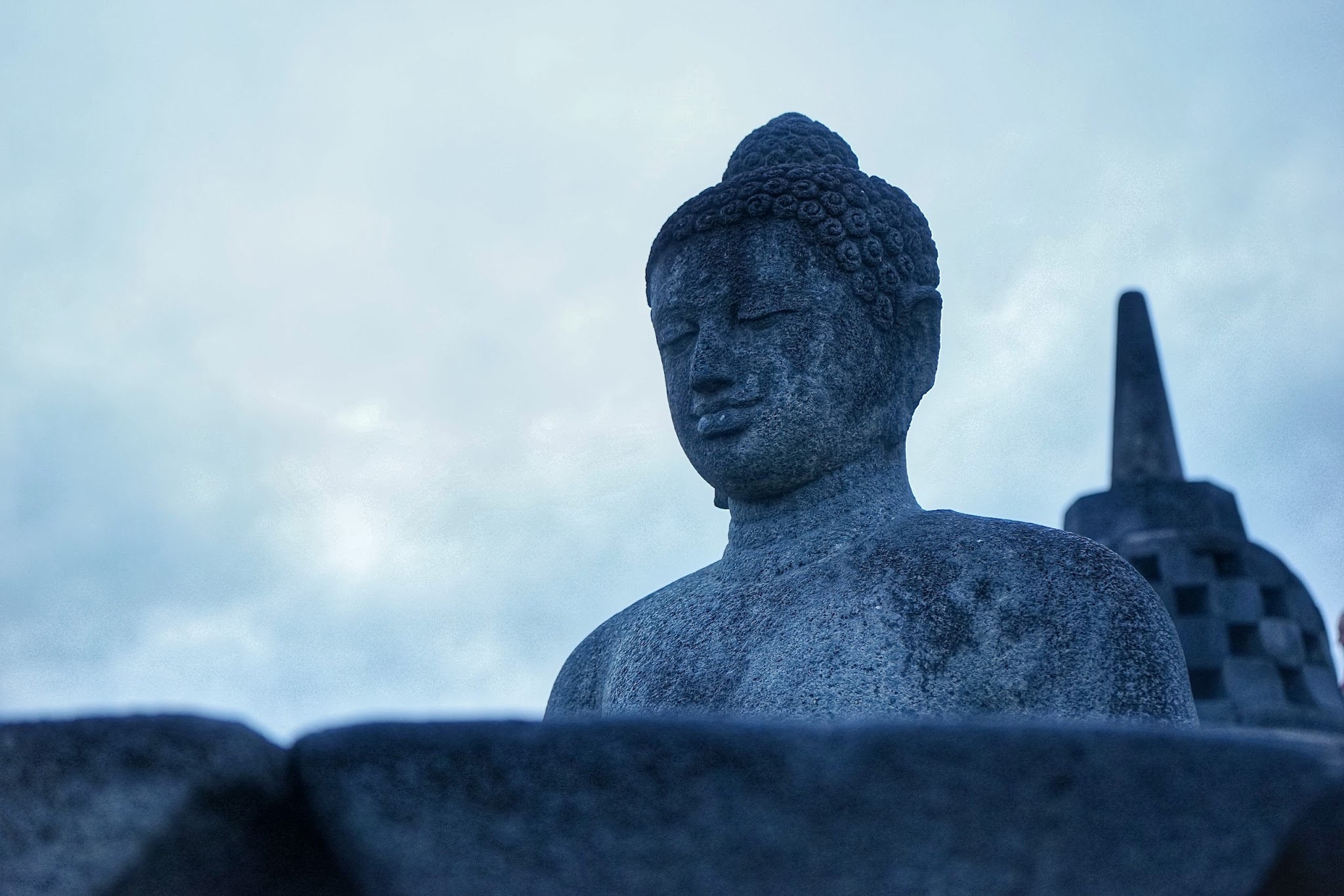
The next day we signed up for a guided tour of Borobudur - the most famous of the temples in Java (and probably the most popular tourist destination in all of Indonesia). This Buddhist temple was built in the 9th century and is literally wrapped around a large hill surrounded by jungle and mountains on all sides. This temple was only 're-discovered' not too long ago in the 1900's and has since gone through several stages of restoration. The result is a pretty amazing 9-level mega-stupa that is covered from head to toe in very detailed stone carvings depicting many sacred Buddhist stories including Prince Siddhartha's journey to eventually become the first Buddha. For our tour we opted to go with Kaleidoscope of Java - run by a man who actually grew up in Borobudur village. For the tour we started with an early-morning climb to the top of the temple complex to watch the sunrise. It then followed with a little bit of exposure to Javanese culture and local village life. The combination of the pre-dawn blue-light mixed with the orange intensity of the rising sun was spectacular.

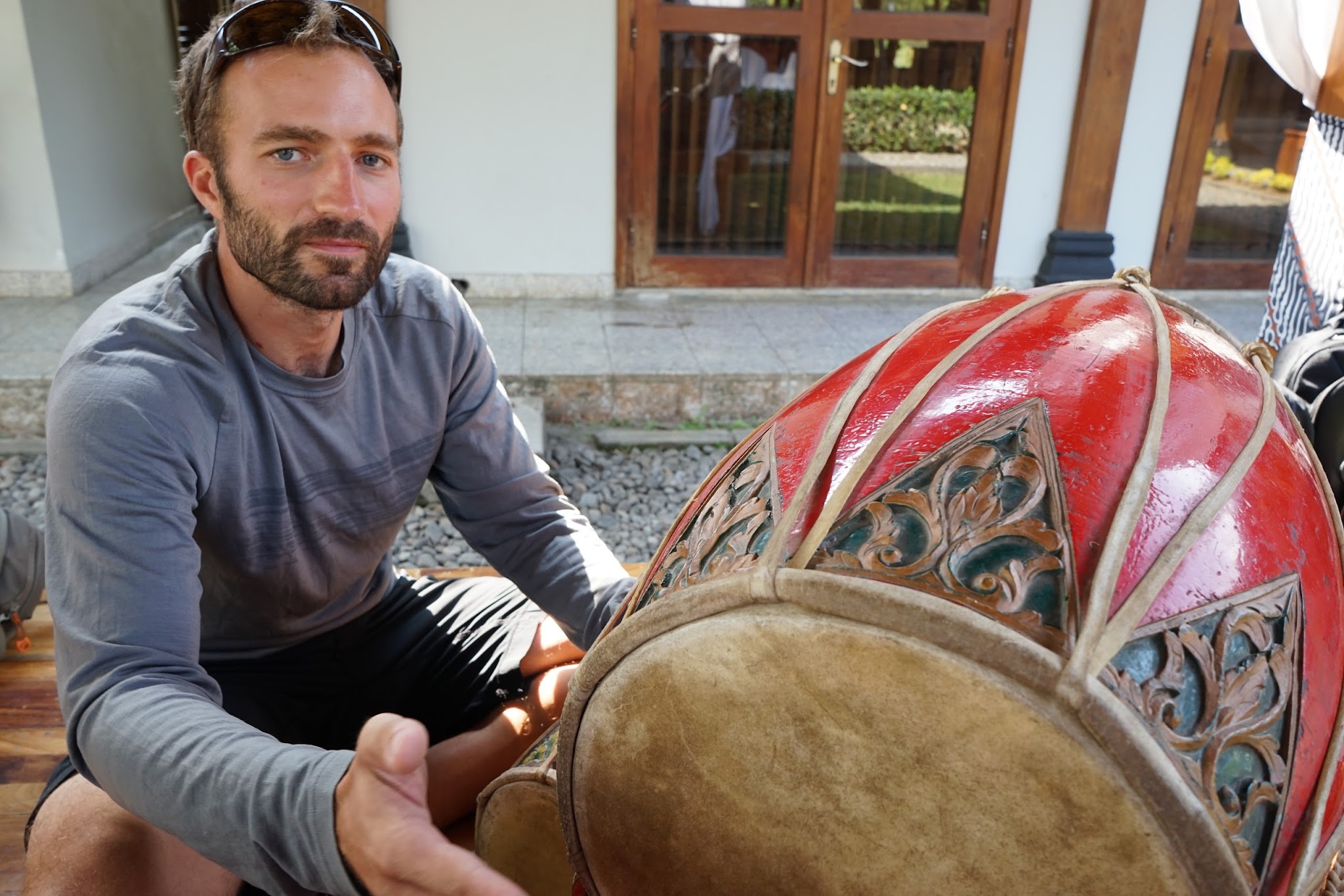
Us trying our hand at Javanese gamelan - we sounded like a 3rd grade band recital.

I got the easy job...

We also stopped at two local villages - the first is known for its tofu (litterally everyone in town makes tofu and tempe for a living).

The second village is known for its ceramics, which are still made in the traditional way from local clay, and fired (litterally) in huge bon fires in the front yards of the residents. Some of these ladies were like mini-pottery factories with hundreds of pieces in-progress out in the sun drying in the front yard.

Marie also gave it a try - attempting to make a stupa shaped ashtray (with a lot of guidance). Not bad for a first try.

From here our plan is to head east overland toward Bali, with a stop at some volcanos along the way!

Click here for more photos.